

 Nepal
is among the poorest countries in the world like Bangladesh, Bhutan, Cambodia,
Ethiopia, Gambia, Haiti, Uganda, Tanzania, Vanuatu, Yemen, and Zambia. Nepal's
annual economic growth rate is less than 2 percent. According to CIA World
Fact book, March 2005, Nepal is the 48th poorest country in the world.
Nepal
is among the poorest countries in the world like Bangladesh, Bhutan, Cambodia,
Ethiopia, Gambia, Haiti, Uganda, Tanzania, Vanuatu, Yemen, and Zambia. Nepal's
annual economic growth rate is less than 2 percent. According to CIA World
Fact book, March 2005, Nepal is the 48th poorest country in the world. Nepal’s
population in terms of race and language can be divided into two main groups:
the Aryans, an Indo-European speaking group, and the Mongolian Tibetan-Burmese
speaking ethnic groups. Nepali, a language originating from Sanskrit, is the
mother tongue of about 60% of the population. About one quarter speak Newari
and the remainder speak other other languages such as Hindi, Urdu and Maithili.
The majority of the population is Hindu, the state religion.
Nepal’s
population in terms of race and language can be divided into two main groups:
the Aryans, an Indo-European speaking group, and the Mongolian Tibetan-Burmese
speaking ethnic groups. Nepali, a language originating from Sanskrit, is the
mother tongue of about 60% of the population. About one quarter speak Newari
and the remainder speak other other languages such as Hindi, Urdu and Maithili.
The majority of the population is Hindu, the state religion. Nepal's
half the population live below the poverty line, and about one third of the
population lives without clear water. These are people who do not have access
to basic needs such as food, health and education. Half the children are
malnourished and under weight. Half the people are jobless in Nepal.
Nepal's
half the population live below the poverty line, and about one third of the
population lives without clear water. These are people who do not have access
to basic needs such as food, health and education. Half the children are
malnourished and under weight. Half the people are jobless in Nepal.
 Life
in Villages: Youth have left their homes or have joined the rebels or have
been killed in the civil war between the rebels and the government. Most
villages are empty, what ever they have are the old and sick parents unable
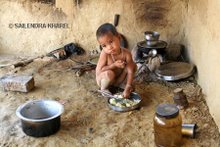
to make it to the city, and trying to survive the best they can. Kids spend
most of their daily life doing house-hold works. Because of the civil war,
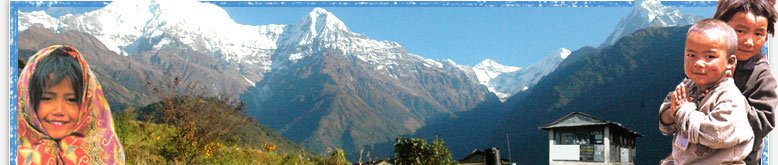
Nepal's beautiful villages with magnificent mountains and landscape are as
empty as ghost town.
Life
in Villages: Youth have left their homes or have joined the rebels or have
been killed in the civil war between the rebels and the government. Most
villages are empty, what ever they have are the old and sick parents unable
to make it to the city, and trying to survive the best they can. Kids spend
most of their daily life doing house-hold works. Because of the civil war,
Nepal's beautiful villages with magnificent mountains and landscape are as
empty as ghost town. Nepal
is one of the poorest countries in the world and was listed as the
eleventh poorest among 121 countries in 1989. Estimates of its per
capita income for 1988 ranged from US$158 to US$180. Various factors
contributed to the economic underdevelopment--including terrain, lack of
resource endowment, landlocked position, lack of institutions for
modernization, weak infrastructure, and a lack of policies conducive to
development
Nepal
is one of the poorest countries in the world and was listed as the
eleventh poorest among 121 countries in 1989. Estimates of its per
capita income for 1988 ranged from US$158 to US$180. Various factors
contributed to the economic underdevelopment--including terrain, lack of
resource endowment, landlocked position, lack of institutions for
modernization, weak infrastructure, and a lack of policies conducive to
development
 Access
to financial services remains limited for most people in Nepal and has
declined in recent years, according to the World Bank and DFID’s 2006
Access to Financial Services Survey report launched today. The report
examines the country’s supply of and demand for financial services,
constraints to increasing access, and offers recommendations for making
the financial sector work for all Nepalese, especially the poor. The
report finds
Access
to financial services remains limited for most people in Nepal and has
declined in recent years, according to the World Bank and DFID’s 2006
Access to Financial Services Survey report launched today. The report
examines the country’s supply of and demand for financial services,
constraints to increasing access, and offers recommendations for making
the financial sector work for all Nepalese, especially the poor. The
report finds
 The
Nepalese rural sector, during the period of about a decade and a half,
has witnessed tremendous growth in microfinance institutions (MFIs). The
MFIs comprise Micro Credit Development Banks, Saving and Credit
Cooperatives (SCCos), Financial Intermediary Non-Governmental
Organization (FI-NGOs), Small Farmer Cooperatives and others, which
offer a variety of microfinance products/services according to the
The
Nepalese rural sector, during the period of about a decade and a half,
has witnessed tremendous growth in microfinance institutions (MFIs). The
MFIs comprise Micro Credit Development Banks, Saving and Credit
Cooperatives (SCCos), Financial Intermediary Non-Governmental
Organization (FI-NGOs), Small Farmer Cooperatives and others, which
offer a variety of microfinance products/services according to the
 Nepal
is one of the poorest country in the world and the poorest in the South
Asia region. Its poverty reduction rate is low. The main reasons for
this low poverty reduction rate are: (i) low per capital income, (ii)
concentrated urban growth, and (iii) high population growth rate. Out of
a population of 23 million, 38% are in below the poverty line. Most of
the poor people live in rural areas and have little opportunity.
Micro-finance could help poor
Nepal
is one of the poorest country in the world and the poorest in the South
Asia region. Its poverty reduction rate is low. The main reasons for
this low poverty reduction rate are: (i) low per capital income, (ii)
concentrated urban growth, and (iii) high population growth rate. Out of
a population of 23 million, 38% are in below the poverty line. Most of
the poor people live in rural areas and have little opportunity.
Micro-finance could help poor
Where is Nepal?Nepal is a small, landlocked country squeezed in between India and Tibet in South Central Asia:
Introduction to NepalNepal is a small, landlocked country sandwiched between India and the Tibet region of China. It makes up 0.1% of the earth, but has 2% of the world's plants, 8% of the world's population of birds, and 4% of the world's mammals. The 26.5 million people who live in this country are only 0.4% of the world's population.
Nepal is home to the vast mountain range of the Himalayas. This tiny country has 10 of the 14 highest mountains in the world, including Mount Everest, the highest peak in the world at 29,025 feet (8850 meters). Only 8% of Nepalese people live in the Himalayan region, and many of them move between summer villages higher up to lower ones in the harsh winter. Because of the bad weather and a short growing season, not many crops are grown in the Himalayan region. Instead, the locals rely on herding and trading of animals.
Below the mountains lie many rushing rivers and rolling hills of the Middle Hills region, which includes Kathmandu and the large towns of Pokhara, and Patan. This region is home to 45% of the population. Nepali farmers plant small fields of crops on the hills here, which form "terraces" that can be seen throughout the hilly part of the country. Here the farmers grow wheat, rice, and vegetables. Below these terraced fields lies the Terai (pronounced "te-rye") plains, where 50% of the Nepali people live. Most people live in small villages of 40 or 50 houses located in the center of the area that is being farmed. The highest point of these plains is only 1,000 feet - 28,000 feet below the top of the Himalayas! Every year in this region there is a season of heavy rains, called monsoons, which bring downpours almost every day between June and August. The rain makes the vegetation lush and green, but too much of it can lead to flooding and landslides.
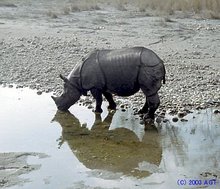
The Terai is also composed of some jungle areas, home to tigers, leopards, rhinoceroses, wild boars, elephants, and deer. However, much of the jungle that used to be home to these animals has been turned into fields for farming, resulting in instances of conflict between animals and humans. The capital of Nepal is Kathmandu. Over 1 million people live in Kathmandu, with another 1.5 million living close by in the Kathmandu valley. The city is busy, with thousands of people walking around, visiting the many shops and markets.
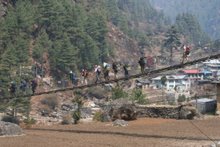
One of the most popular ways to get around the city is the rickshaw. It is a large tricycle that is used as a taxi, carrying up to 3 people in the back. It is one of the cheapest ways to get around the city. Tempos, or Tuk Tuks, are 3-wheeled, motorized scooters that carry several passengers and are another common, inexpensive way to get around. Car taxis are available too, but are more expensive than rickshaws and not as commonly used. Most people just walk everywhere. Nearly 86% of all Nepali people live outside of the cities, often in small villages near water sources. These settlements sometimes move from one place to another to take advantage of the varying climates at different altitudes throughout the year. People live in houses made of stone and mud or bamboo and wood. Usually people live close to where they earn their living. The most common jobs involve farming or occupations related to farming. Outside of the city, the most popular way to get anywhere is to walk. In the Middle Plains region and above, often there are large canyons that must be crossed. Before simple walking bridges were built, people had to walk down to the bottom of the canyon, cross the river, and climb up the other side. In areas away from roads, many Nepalis use mules or yaks to transport food and other supplies to villages. Groups of 20 or so mules form a mule train, which is driven by one or two people. Each mule can carry several hundred pounds on its back and walk for many miles each day.
Yaks are big, hairy animals that are closely related to cows. They live in the cold, mountainous region of the Himalayas. A yak bull can grow to be 8 to 9 feet long, 6 feet tall at the shoulder hump and 1,200 pounds in weight. Despite their size, they are very agile animals, good climbers, and good swimmers. They graze on the alpine grasslands in the summer and on the shrubs in deep snow during winter. Yaks can be recognized by their impressive coat of long hair that sometimes hangs to the ground. They usually have blackish-brown hair, but their coats may also be red or brown with white. For thousands of years, yaks have been domesticated and used for transportation. They may travel 20-30 km per day with a load of 100-200 pounds on the high, cold, steep mountainous paths. Yaks are also used for their milk, meat, and leather.
Nepal is home to as many as 60 different ethnic groups; many of these groups are descendents from Tibet and Burma and include the Brahman (the traditional Hindu priest caste, or group), the Gurung, Magar, Rai, Limbu, and Thakali. The Sherpas and the Gurkhas are two Nepalese groups that have gained attention due to their special skills. Sherpas, a Himalayan people, are famous for their work at high altitudes, carrying heavy loads for tourists, merchants and expeditions. The Gurkhas are renown for their fierce fighting skills and have been employed by both India and Great Britain to serve in their respective militaries. Although Nepali is Nepal's official language and is spoken by nearly 50% of the people, many people speak in one of the 20 major languages that are found throughout Nepal. Nepali script, known as Devanagari, is related to Sanskrit. For this reason, translations into the English alphabet can have many different spellings. More people are learning to speak English so that they can work in Nepal's tourist industry.
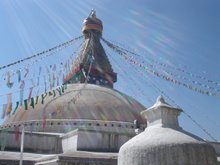
Hinduism is the country's official religion. Nepal is the only official Hindu nation in the world. 80% of the population is Hindi, while another 11% is Buddhist; however, the Nepalese often combine the beliefs found in Hinduism and Buddhism. Buddha, the founder of Buddhism, was born in Nepal in 563 B.C. Temples and shrines from either religion are considered to be equally sacred, and the Nepalese celebrate the festivals and holidays of both religions. Cows are sacred animals in Nepal. They are not used for beef, nor are they used to help with work. They bear calves and provide milk. In Nepal you will see cows wandering and sleeping in the streets. It is a crime to kill a cow, and supposedly the punishment can be as much as 12 years in jail! The traditional way to greet someone in Nepal is by saying "namaste" (na-ma-stay). Namaste means, "I honor the place in which the entire universe dwells. I honor the place in you which is of love, of truth, of peace and of light. When you are in that place in you and I am in that place in me, we are one." This is a way of paying honor to another's sacredness. A person places their palms together (fingers up) in front of the chest or chin and says "Namaste" or "Namaskar" for superiors or elders. According to custom, an adult does not say "namaste" to a child unless the child does so first, in which case the adult may reciprocate.
The traditional food in Nepal is called dahl baht (learn to make dhal bhat on our website). This is made of rice and lentil soup, curried vegetables and chutney. Hindus never eat beef because they consider the cow a sacred animal. In Nepal, children play a variety of sports and games, including soccer, volleyball, badminton, and kite flying. Board games such as chess, LUDO, and Carom are very popular as well. Nepal is also a country of many festivals and celebrations. Dates for these holidays are based on the Nepalese calendar, Bikram Samvat, which is based on the phases of the moon. Dashain is a two-week festival in September and October when gifts are exchanged, feasts are consumed, and people celebrate virtue over evil. The Goddess of Victory is adorned during this period. During Tihar, rows of lights glow through every building to signify the Goddess of Wealth. People sing throughout the streets for these three days in October or November. A livelier holiday is Holi. This is a social event, during February or March, which incorporates a lot of drinking, dancing and colorful powders, which are thrown onto friends and family.
80% of the Nepalis who work are involved in agriculture. Nepal's economy depends almost entirely on farming. Rice, jute, spices, carpet and clothing are Nepal's chief exports. However, there are few paved roads or railroads, making trade difficult. Tourism is the second most important industry in Nepal. This small country is famous for its hiking and river rafting. The money tourists spend in Nepal is of vital importance to the survival of the overall economy. Over fifty percent of Nepali people need more work to lift themselves out of poverty. In 1994, a Communist-led coalition began to gain support among the poor farmers and dissatisfied public. In 1996, this group, now referred to as the Maoists, declared a "People's War" to replace the country's existing government with a republic, essentially transferring the power from the ruling class to the masses. The Maoist conflict has resulted in the loss of thousands of lives, the destruction of much-needed infrastructure, and the loss of many basic freedoms. The outcome of this conflict will likely depend on whether the Maoists are willing to negotiate a settlement. |


|
Nepal is a
landlocked and largely undeveloped country nestled in the heart of the
majestic Himalayan Mountains, with China to the north and India to the
south. Currently struggling with abject poverty, political upheaval,
economic uncertainty and gender inequality, children there find themselves
orphaned due to disease, natural disasters, and lack of access to medical
facilities. On the
other hand, Nepal has an astonishing diversity of geography and richness of
culture for such a small country. On the same day, one can brush against the
world's highest peaks on a mountain flight, browse World Heritage Site
temples and ride through grasslands and jungles atop an elephant. |
|
|
|
While many children here live in poverty, they are much more
fortunate than the orphans and homeless children who live on the streets. A
UN report states that there are over 5000 orphans in Nepal. In the most
recent CWIN (Child Welfare In Nepal) report it is noted that more than 3000
children have been displaced and over 1500 orphaned due to the violent
political conflict in this country. The current political situation has made
everyday life a struggle; prices have risen from countrywide blockades,
tourism is down, and many young adults have fled the country or been injured
or killed as a result of the political tensions. The orphans
and street children of
Nepal,
marginalized by society, are vulnerable to various abuses: they are bought
into indentured servitude, sold into the sex trade industry etc. More often
than not they are also introduced to the street life culture of drugs and
crime.
Geographical Information: Nepal, a sovereign
Independent Kingdom, lies between 80 degree 12' east longitude and 26 degree
22' and 30 degree 27' north latitude. It is bounded on the north by the
Tibet Autonomous Region of the People's Republic of China; on the east by
Sikkim and West Bengal of the Indian Union on the south by Indian States of
Bihar and Uttar Pradesh and on the west by Uttar Pradesh of Indian Union.
The length of the Kingdom is 885 kilometers east-west and its breath varies
from 145 to 241 kilometers north-south. Climatically, it lies in the
temperate zone with the added advantage of altitude. |
| >>
www.welcomenepal.com >> www.nepal.com >> www.visitnepal.com |

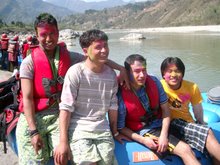
Holy Festival with Rafting


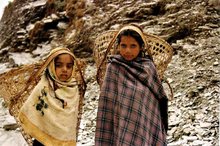
Child Labour in Nepal
Suspension Bridge
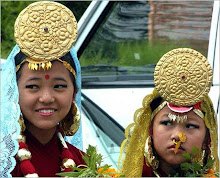
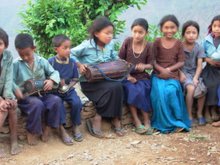
Singing Children
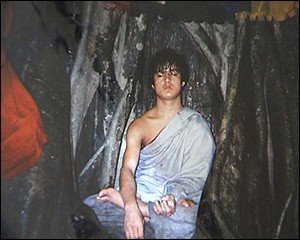
New Buddha ?